Image by Tessa Lindqvist
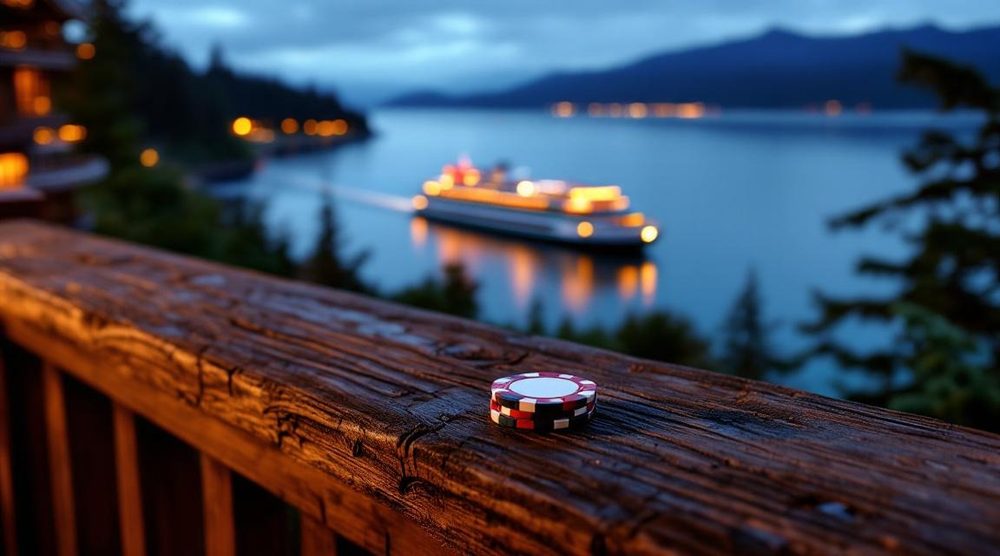
Seattle takes its name from si?a?, the Suquamish and Duwamish leader known in English as Chief Seattle. He was the first to place his mark on the Point Elliott Treaty in January 1855, and he was buried at Suquamish in 1866, across the water from the city that now carries his name. The Suquamish Tribe’s casino resort stands on that side of the Sound today, beside Agate Passage.
Suquamish is one stop on a ring of tribal casino resorts around Puget Sound. Tulalip meets Interstate 5 north of Everett, Snoqualmie sits off Interstate 90 in the Snoqualmie Valley, Muckleshoot and the Emerald Queen cover the south in Auburn and Tacoma, and The Point Casino & Hotel stands a short drive from the Kingston ferry dock.
Each belongs to a tribal government, and each tribe reached the casino business by its own road. Since 2021, several have also opened sportsbooks, a change that began at Snoqualmie with a bet from a retired SuperSonics star.
Washington Left Casino Gaming To The Tribes
Washington lets bars sell pull-tabs and card rooms run table games, but casinos are tribal businesses. State Sen. Steve Conway, a nonvoting member of the Washington State Gambling Commission, put it plainly in a Seattle Times story published in January: “casino gaming is exclusive to the tribes.” Twenty-two tribes run gaming properties, according to the Washington Indian Gaming Association.
That arrangement grew from a 1987 U.S. Supreme Court ruling, California v. Cabazon Band of Mission Indians, which found that states could not regulate tribal gaming. Congress followed in 1988 with the Indian Gaming Regulatory Act, which requires a compact between a tribe and its state before casino games can open. The Tulalip Tribes signed Washington’s first compact in 1991.
The revenue goes to tribal governments rather than outside investors, and the gaming association credits it with building the Lummi Nation’s Northwest Indian College and the Tulalip Tribes’ Lushootseed Language Department.
Tribal history around the Sound runs through three treaties that Territorial Governor Isaac Stevens negotiated in 1854 and 1855. The Point Elliott Treaty set aside reservations at Tulalip and at Port Madison, home of the Suquamish. The Treaty of Medicine Creek, signed on December 26, 1854, covered tribes of the southern Sound, and the Point No Point Treaty followed on January 26, 1855, with the S’Klallam of Hood Canal.
Tulalip And Snoqualmie Sit Beside The Interstates
Tulalip moved into gaming early. The Tulalip Tribes, a confederation of Snohomish, Snoqualmie, Skykomish, Stillaguamish and related peoples, opened a bingo parlor on June 13, 1983 and their first casino on July 20, 1992, with 23 gambling stations for blackjack, craps, roulette and poker.
Their reservation meets Interstate 5 near Marysville, where Quil Ceda Village, a shopping district the tribes began in 2001, now includes Seattle Premium Outlets. Tulalip Resort Casino opened on June 5, 2003, and an expansion of the resort followed on July 3, 2025. The Hibulb Cultural Center, open since 2011, tells the Tulalip and Snohomish story through a longhouse, a canoe hall and a natural history preserve.
Snoqualmie took a slower route. Snoqualmie leaders also signed the Point Elliott Treaty, but it never gave the tribe a reservation of its own, and the tribe’s casino did not open until 2008, off Interstate 90 at Exit 27 near North Bend. It ran without a hotel for 17 years.
That changed in August 2025. Skanska, the contractor behind the original 185,000-square-foot casino, completed a 210-room hotel whose slanted roof takes its cue from traditional longhouses, along with a 2,000-seat entertainment and convention center.
Muckleshoot And The Emerald Queen Hold The South End
The Muckleshoot Reservation lies between Auburn and Enumclaw, on land that Stevens recommended for the Green and White river tribes on December 5, 1856, after the Medicine Creek Treaty left them unnamed. Starting in 1995, the tribe built a mall, a casino and the White River Amphitheater. The casino on Auburn Way South has since grown into a resort with 401 rooms in an 18-story tower.
The Puyallup Tribe of Indians, whose gaming compact dates from 1996, brought casino gaming to Tacoma that December with a waterfront venue on the tideflats. Port development closed the site in 2004, the same year the tribe opened its Emerald Queen casino and hotel in Fife.
The tribe’s newer casino opened in 2020 beside Interstate 5 in Tacoma, a 310,000-square-foot building with a 155-room hotel tower, as South Sound Magazine recounted in its history of the Emerald Queen.
Light rail does not reach either resort. Sound Transit’s 1 Line opened to Federal Way on December 6, 2025, and the extension to Tacoma Dome Station is still to come, so the trip south ends with a drive or another transfer.
Shawn Kemp Placed The State’s First Legal Sports Bet
Sports betting reached these resorts through the same compacts. Gov. Jay Inslee signed House Bill 2638 in March 2020, and the Washington State Gambling Commission says the law “authoriz[es] sports wagering on a very limited basis by restricting it to tribal casinos.” Each tribe then had to amend its compact before taking a bet.
The first counter opened at Snoqualmie Casino on September 9, 2021. Former SuperSonics star Shawn Kemp went to the front of the line and made Washington’s first legal sports wager, on the Seahawks’ opener at Indianapolis, in a room that had held slot machines.
Tulalip signed a sportsbook partnership in 2022 and added a betting app in 2023. The commission requires every sportsbook to sit inside a tribe’s gaming facility and every mobile wager to pass a geofence confirming the bettor is on the premises.
Away from those premises, the law is blunt. Washington’s gambling statute makes knowingly transmitting or receiving gambling information over the internet a class C felony, and its exception covers only authorized activity such as the on-premises wagering the compacts allow.
Online sportsbooks operate in markets where a government has licensed companies to take wagers over the internet, the category LineUps’ guide to Betting websites covers. Washington has not created that kind of market, so online sportsbooks have no legal role on a trip around the Sound.

Lawmakers did change what the counters can accept. When the Snoqualmie sportsbook opened, KUOW noted that games involving in-state colleges were excluded. Senate Bill 6137, which Gov. Bob Ferguson approved on March 30, 2026, took effect on June 11 and allows wagers on college games involving Washington schools.
The same law still bars bets on the performance of an individual in-state college athlete and on in-game coaching calls or officiating decisions in those schools’ games. It also made threatening a sports official, coach or participant over a wager a gross misdemeanor.
The next change is likely to come the same way, through a bill in Olympia, the kind of update worth following in local reporting or on betting news feeds such as @Lineups_US on X.
Two Ferry Routes Reach The Kitsap Resorts
The two resorts across the water start with a ferry. Washington State Ferries lists the Seattle to Bainbridge Island crossing at about 35 minutes, and from the Winslow terminal the road runs across the island and over the Agate Pass Bridge, open since October 1950, onto the Port Madison Reservation.
Suquamish Clearwater Casino Resort sits on a wooded bluff above Agate Passage and has 183 guest rooms. The Suquamish Tribe that owns it counts about 1,500 enrolled members, one of the smallest of Washington’s 29 federally recognized tribes, according to a Seattle Times feature published in April.
In the village of Suquamish, visitors are welcome at Chief Seattle’s grave in the Suquamish Tribal Cemetery, where two 12-foot cedar story poles flank the headstone. The marker, placed by Seattle residents around 1890, gives his baptismal name as Noah Sealth.
Across the street, the Suquamish Museum opened in 2012 in a 9,000-square-foot building designed to echo a longhouse. Old Man House Park, a two-minute drive away, marks the beach where a longhouse that housed Chief Seattle and his people stood until federal agents burned it in 1870.
The Edmonds to Kingston route serves the north end of the peninsula. The Point Casino & Hotel, run by the Port Gamble S’Klallam Tribe, puts that crossing at 30 minutes and the casino about 10 minutes from the Kingston terminal. Its directions also send drivers from the Bainbridge ferry through Suquamish, which links both Kitsap resorts in one loop.
The tribe’s reservation at Point Julia, the village long called Little Boston, dates from June 16, 1938. S’Klallam families had fished Hood Canal long before, and they called the Port Gamble townsite across the bay Teekalet, meaning “brightness of the noonday sun.”
The Minimum Age Changes Between Neighboring Casinos
Age rules are set casino by casino, even within one tribe. The Tulalip Tribes admit players from 18 at Tulalip Bingo & Slots on Quil Ceda Way but require guests to be 21 to enter and gamble at Quil Ceda Creek Casino and at the resort. The main resort at each stop compares this way:
| Resort | Owned by | From downtown Seattle | Age to gamble |
| Tulalip Resort Casino | Tulalip Tribes | Interstate 5 north to Quil Ceda Village | 21 |
| Snoqualmie Casino & Hotel | Snoqualmie Indian Tribe | Interstate 90 east to Exit 27 | 21 |
| Muckleshoot Casino Resort | Muckleshoot Indian Tribe | South to Auburn Way South in Auburn | 21 |
| Emerald Queen Casino Tacoma | Puyallup Tribe of Indians | Interstate 5 south to Tacoma | 21 |
| Suquamish Clearwater Casino Resort | Suquamish Tribe | Bainbridge Island ferry, then the Agate Pass Bridge | 18 |
| The Point Casino & Hotel | Port Gamble S’Klallam Tribe | Edmonds to Kingston ferry | 21 |
Washington’s problem gambling helpline, run around the clock by the Evergreen Council on Problem Gambling, takes calls and texts at 1-800-547-6133.


Leave a Reply