
Image: Casey Hayes
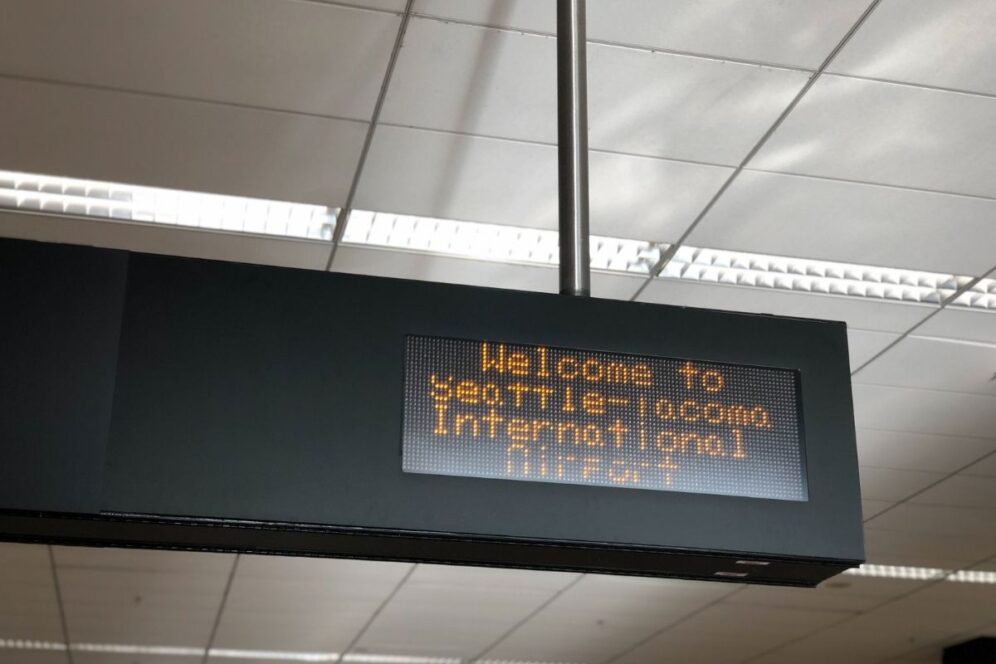
A full slot animation will finish loading before your work email syncs. That is not a guess, it is a plain fact of how airport Wi-Fi rations bandwidth, and anyone who has sat near Gate A at SeaTac watching the spinner crawl already knows it. The connection is not dead. It is throttled, sipped out in tiny allotments to thousands of travelers at once, and the things that survive that trickle are rarely the things you expected.
I spend a lot of time in Seattle-Tacoma International between long-haul legs, and I sort apps by weight the way I sort a carry-on. Heavy sync jobs stall. Small, self-contained pages sail through. For a concrete example of the second kind, Bonus.com’s free slots casino resources collects browser-based demo games that load their assets once and then run entirely in the tab, which is exactly the profile that survives a starved connection. I am not telling you to gamble in a terminal, only showing what “lightweight” really means when the pipe is choked.
Below is the field guide I wish I had during my first four-hour delay: what loads, what does not, and why the difference has little to do with how “important” the app feels.
Lightweight, defined: bytes, not vibes
A connection does not care about your priorities. It moves bytes, slowly, when a few thousand people share one antenna. So the useful question is never “is this important,” it is “how many round trips does this thing need before it shows me anything.” An app that phones a server every few seconds is fragile on a trickle. A page that pulls its files once and then computes locally is durable.
That distinction explains most frustration at the gate. Your mail client needs many small conversations with a distant server to reconcile a mailbox. A cached article, a downloaded map, or a game whose logic already lives in your browser needs almost none. Weight, here, means chattiness, not file size alone.
The categories that survive a throttled pipe
Group airport-usable things by how they talk to the network, and a hierarchy appears.
– Already-downloaded content: offline maps, saved articles, synced music. Zero network needed, so a throttle cannot touch it.
– Load-once, run-local pages: browser games, calculators, single-page tools. One burst to fetch assets, then silence.

– Text-first services: plain messaging, boarding-pass wallets, low-resolution pages. Small payloads that squeeze through gaps.
– Streaming and heavy sync: video, cloud photo backup, large mailboxes. These assume a fat, steady pipe and stall the instant it narrows.
The counterintuitive part is that a visually busy thing, a slot demo with spinning reels, can sit in the second tier and outperform a plain mail app stuck in the fourth.
Trade-offs: what you surrender to stay loaded
Staying reliably loaded is not free. Everything in the durable tiers buys resilience by giving something up. Offline content is fixed: your saved map will not show the restaurant that opened last week. Load-once tools are sealed, so a free slot demo never touches your money or a live server, which is why it keeps working, but that also means nothing in it is real stakes or real winnings. The pattern is consistent: the more a service leans on the live network, the more it does when the network is healthy, and the harder it falls when it is not.

A worked comparison: a three-hour SeaTac delay
Watch one delayed evening and the tiers sort themselves in real time.
| Phase | What happened |
|---|---|
| 6:10 pm, boarding posted | Wi-Fi snappy, light crowd, everything loads, even video |
| 6:40 pm, delay announced | Hundreds reconnect at once, mail sync starts choking |
| 7:15 pm, gate packed | Streaming buffers endlessly, offline maps and cached articles unaffected |
| 8:00 pm, second delay | Only load-once pages and text messaging still respond quickly |
| 8:50 pm, finally boarding | Congestion eases as travelers queue and close their tabs |
By 8:00 the picture is stark. The heavy syncers are frozen, and the survivors either need no network or asked for it once and let go.
Pitfalls that eat your last two bars
A few habits quietly wreck a thin connection. Background photo backup is the worst offender, uploading gigabytes while you wonder why a webpage will not open, so turn it off before you land. Auto-playing video drains the same pipe you need for your boarding pass. And open Wi-Fi is not private, so treat a public airport network as if a stranger can see it, because one plainly can. Comparing a demo to real-money play deserves the same clear eye: a free slot is a sealed toy, while real-money slots run on a published return-to-player figure and a built-in house edge that no connection speed or lucky streak removes. The math favors the operator by design.
For more groundwork, this walkthrough of how an eSIM smooths Belgian travel applies the same weigh-your-bandwidth thinking to cellular data, often the honest fix when airport Wi-Fi gives up entirely.
FAQ: mechanics and odds, honestly
Why does a whole slot game load when a single email won’t?
The game fetches its files in one burst and then runs in your browser without further chatter, while email needs many small, slow round trips to a distant server. On a throttled connection, chattiness kills you, not visual complexity.
Are the free slot demos the same as playing for money?
No. A demo runs on play credits inside a sealed page, touches no live wager, and pays nothing real. Real-money play, legal for online casinos in only about seven US states and limited to age 21 and up, involves actual stakes and actual losses.
Does a demo’s results predict real-money odds?
Not reliably. Demos are meant to show mechanics and feel, not to model a specific real-money title’s exact payout. Real games publish a return-to-player percentage, and that long-run figure, not a short demo session, is what describes the odds.
Can any strategy beat the house edge on slots?
No. Slot outcomes are driven by a random number generator, and the house edge is fixed in the design. No timing trick or streak changes the long-run math, which is why a responsible plan treats losses as the expected cost.
Where can I get help if play stops being fun?
In the US, the confidential 1-800-GAMBLER line runs around the clock. Set a firm time and money limit before you start, keep real-money play to age 21 and over where it is legal, and step away the moment it feels like a chore.



Leave a Reply